How to Store Pumped Breast Milk Safely at Home
The pump session ended twenty minutes ago. Three bottles are on the counter, still faintly warm, and your baby is finally asleep. Someone else in the house will give the next feed, maybe you, maybe your partner, maybe the sitter at seven tomorrow morning.
That's usually when the questions arrive. Can these sit out until the next feed? Should they go straight to the freezer? If someone warms a bottle and the baby only takes half, what happens to the rest?
Knowing how to store pumped breast milk turns out to be less about memorizing a chart and more about making every container readable. A bottle carrying a pumping time, a current state and a discard deadline answers the safety question for whoever opens the fridge at 3 a.m. This walkthrough follows each stage in order, from the moment milk leaves your body to the moment a caregiver decides whether the last ounce is still good. None of it replaces advice about your own baby. For anything specific to your child's health, feeding or medication, ask a pediatrician or a lactation professional.
Table of Contents
- How Long Pumped Milk Lasts in Each Place
- How to Cool and Label Milk Before Storing
- How to Thaw and Warm Stored Milk Safely
- What to Do With Milk After a Feed Starts
- When Storage Conditions Go Wrong
- Hand Off Milk Clearly and Set Up One Log
How Long Pumped Milk Lasts in Each Place
The bottles are capped, the pump parts are in the sink, and the decision is small but immediate: counter, fridge or freezer.
The U.S. Centers for Disease Control and Prevention (CDC) publishes the framework most U.S. hospitals, daycares and lactation consultants work from, and it rests on two variables, how cold the milk is and how long it has been there (CDC breastfeeding guidance).
| Storage place | Temperature | Time limit | Notes |
|---|---|---|---|
| Room temperature | 77°F (25°C) or colder | Up to 4 hours | Clock starts at pumping |
| Refrigerator | 40°F (4°C) or colder | Up to 4 days | Freeze sooner if it will not be used in time |
| Freezer | 0°F (-18°C) or colder | Best within 6 months | Up to 12 months considered acceptable for quality and safety guidance |
That's the whole reference. The parts people stumble over are underneath it.
The clock starts when you pump
Not when you label the bag, and not when you move it to the fridge. Freshly pumped milk gets its full window from the moment it leaves your breast, so a bottle that sat on the counter for an hour before going into the refrigerator has already spent an hour of a different clock. Writing the time down right away matters more than any other storage habit you'll build.
Temperature matters more than location
The limits above assume room temperature at 77°F (25°C) or colder, a refrigerator at 40°F (4°C) or colder and a freezer at 0°F (-18°C) or colder. A bottle inside a fridge that runs warm isn't protected by the fact that it's in the fridge. Put an inexpensive appliance thermometer on a shelf and glance at it once a week, because that number tells you whether your milk is inside the window you think it is.
Freezer timing is about quality more than safety. Frozen milk is best used within 6 months, and storage for up to 12 months is considered acceptable for quality and safety guidance. Earlier months taste and nourish a little better.
Practical rule: If you already know the milk won't be used within 4 days, freeze it as soon as it's cool instead of leaving it in the fridge to run out its clock.
When to ask instead of look it up
These limits describe freshly expressed milk for healthy, full-term babies. Families of premature or medically complex infants usually receive tighter instructions from their care team, and those instructions win every time.
Most pumped milk gets stored without any trouble at all. Treat the table as a reference to check, not a test to pass.
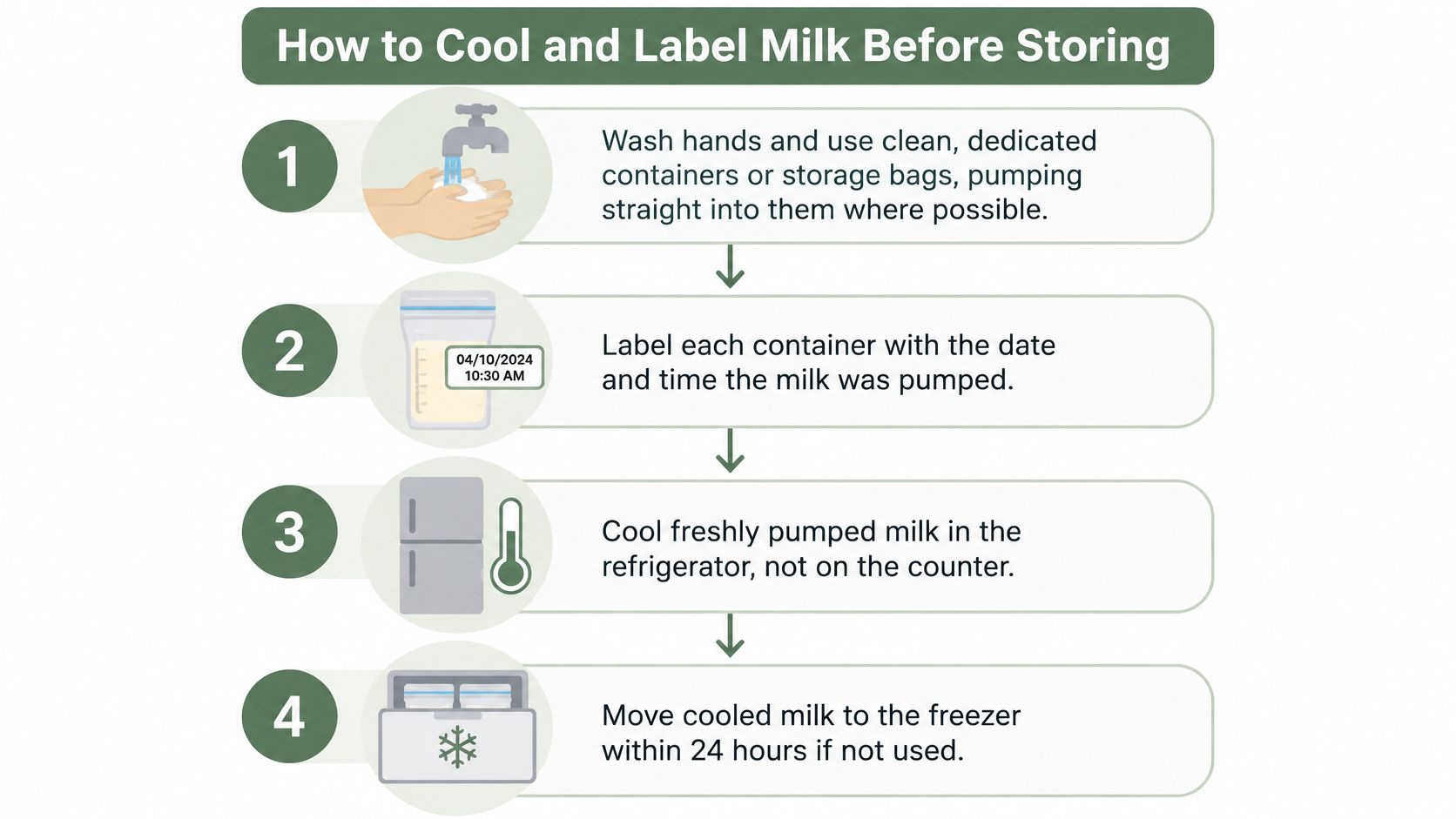
How to Cool and Label Milk Before Storing
A workable routine takes about ninety seconds once it's familiar, and it removes most of the guesswork later. Here it is, in the order you'd do it with a pump still in one hand.
- Start clean and pump into the storage container. Wash your hands and use clean, dedicated bags or bottles, pumping directly into them where you can. Every transfer is a chance for a spill or a stray germ, and doing it in one step removes both.
- Write the date and pumping start time before the container goes anywhere. That timestamp starts every clock that follows, so a bag labeled an hour later is already lying to whoever reads it.
- Cool fresh milk before adding it to milk that's already chilled. Pouring warm milk into a cold batch raises the temperature of everything in that container. Chill the new milk first, combine, then relabel the container with the oldest milk's date.
- Leave headspace. Milk expands as it freezes, and an overfilled bag splits along the seam. An inch of room at the top protects the bag and the ounces inside it.
- Store containers at the back, never in the door. Door shelves swing in temperature every time someone opens the fridge, while the back stays cold and steady.
- Portion into single-feed amounts. Fill each container with roughly what your baby takes at one feeding, so thawing one bottle doesn't commit you to discarding half of it.
- Add the storage place and who pumped it. In a household with a nanny, a grandparent or a daycare, the name on the container matters as much as the date, because it tells the next person who to ask.
The steps above pair naturally with the pumping routine that feeds this whole system, especially if you're still working out flange sizes and session timing.
A well-labeled container reads like a sentence: name, date, time, state. Anyone who opens the fridge can finish that sentence without calling you at work.
How to Thaw and Warm Stored Milk Safely
Frozen milk plays by different rules once it starts to melt, because its remaining window changes with how warm it gets and how long it stays there. The sequence below keeps that change predictable.
- Move the container from the freezer to the refrigerator the night before you need it, or early the same day. Slow thawing keeps the milk coldest for longest.
- Need it sooner? Set the sealed container in lukewarm water or hold it under lukewarm running water until it loosens.
- Skip the microwave and the stovetop entirely. The CDC advises against both because uneven heat creates dangerous hot spots and can damage components of the milk (CDC human milk storage and preparation).
- Swirl, don't shake. Fat separates during storage and blends back in with a gentle rotation of the container. Hard shaking doesn't speed anything up.
- Write the thaw time on the label the moment the last ice disappears, because that moment starts the next clock rather than the moment you took the bag out.
- Reach for the oldest eligible container first so nothing ages out unnoticed at the back of the shelf.
| Stage | Where it happens | Time limit | Rule |
|---|---|---|---|
| Thawed in refrigerator | Refrigerator | Up to 24 hours from the moment milk is fully thawed | Do not refreeze |
| Warmed in lukewarm water | Water at lukewarm temperature | Use within 1 to 2 hours | Never microwave or boil |
| Thawed milk brought to room temperature | Counter or feeding bag | Use within 1 to 2 hours | Use the oldest container first |
The 24-hour count catches people out. It begins when the milk is completely thawed, not when it leaves the freezer, so a bag that took a full day to melt still has its own day in the refrigerator afterward. Once thawed milk is warmed or brought to room temperature, aim to use it within 2 hours, and don't refreeze what's left.
The check before every feed: what state is this container in, and when did that state begin? Fresh, frozen, thawed and warmed each carry a different clock, and the label should tell you which one you're looking at.
What to Do With Milk After a Feed Starts
A bottle your baby has already drunk from is a different object from the one you put in the fridge an hour ago. Saliva enters the milk as your baby feeds, and the bacteria in it keep multiplying once feeding stops, which is why the leftover rule is shorter than every other rule in this guide.
The FDA is direct about it: leftover milk from a feeding should be used within 2 hours after it has been offered to the infant, or discarded, and that applies whether the bottle was left on the counter, in the refrigerator or in the freezer (FDA food safety guidance for new parents). Thawed milk that hasn't touched a baby's mouth keeps the longer window described in the table above.
The most common mistake is quiet and well-intentioned. A parent caps the half-finished bottle, tucks it back in the fridge and plans to finish it at the next feed, not realizing the clock started the moment the first sip happened. The second mistake is warming a full bag when the baby usually takes half of it, which leaves more to discard than necessary.
- Log when the feed started. One time written on a bottle or tapped into a phone makes the 2-hour window visible to everyone, including the caregiver who arrives halfway through it.
- Thaw less than you think you need. A smaller portion can always be topped up with a second container. A large one can't be un-warmed.
- Decide at the mark instead of hoping. When you're unsure whether a bottle is still in its window, discard it and note the time. That's a much smaller loss than feeding something you can't vouch for.
When Storage Conditions Go Wrong
The cooler bag rides the passenger seat through a slow commute. Later the shared office refrigerator runs warmer than anyone checks, or a freezer door stays cracked overnight. The milk is only as safe as the time, the cold, and the look of it that the next caregiver can still read.
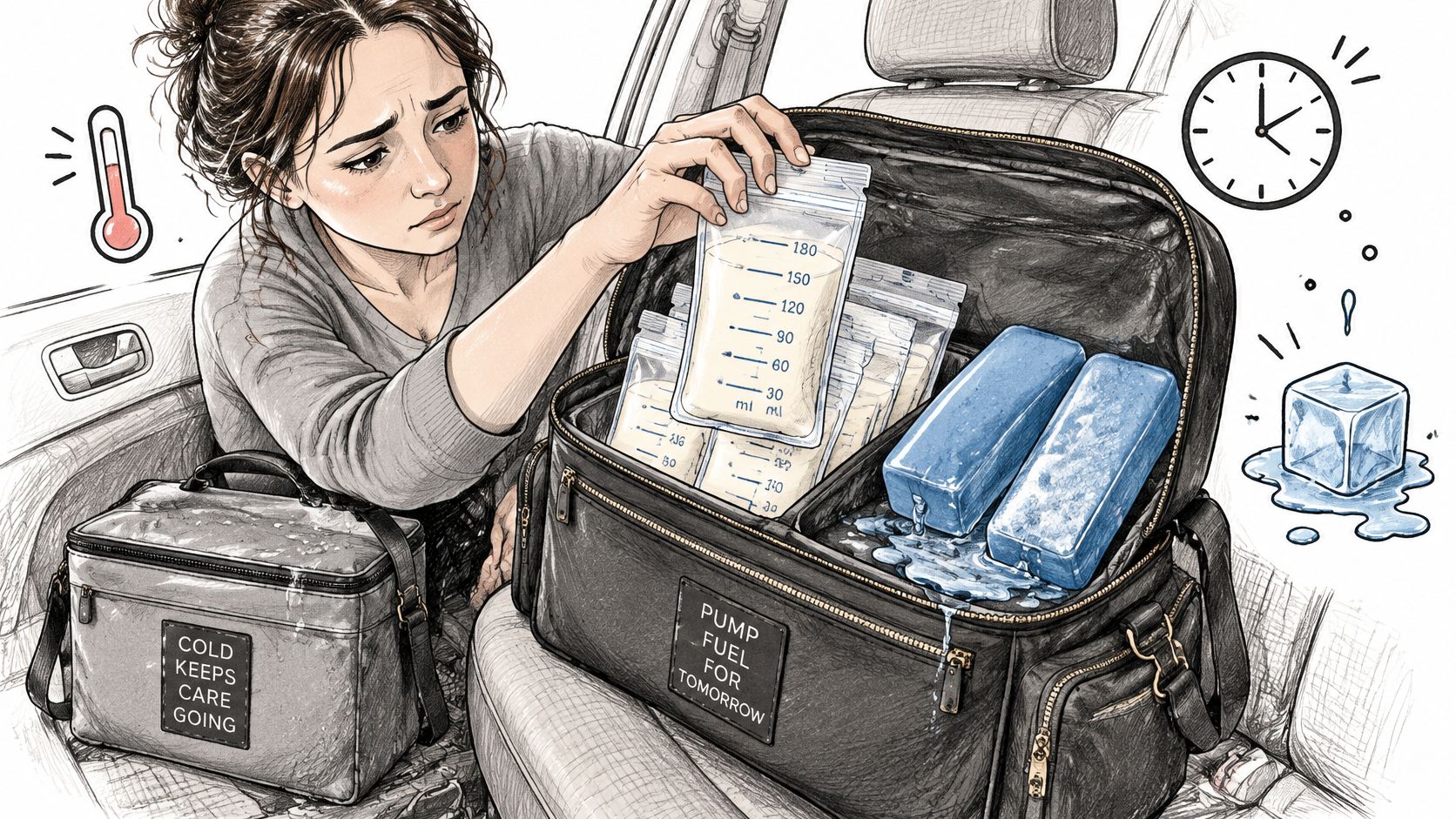
Freshly expressed milk may travel in an insulated cooler with frozen ice packs for up to 24 hours (CDC guidance on returning to work and breastfeeding). That covers a commute, a daycare drop-off, and a long day away from a refrigerator, if the packs stay solid and the milk sits against them. Packs that have melted to water are no longer holding that cold. On arrival, move the milk to a refrigerator or freezer and write the time, so nobody later has to reconstruct the drive.
A freezer problem is quieter. Ice crystals are the visible sign that the milk has not fully left the frozen state. A bag with no crystals left has thawed, even when it still feels cold. Those two appearances need different caution, and neither one comes with a blanket permission to refreeze or a fixed next-day cutoff you can apply from memory. During an outage, keep the door closed. Note when the power dropped and when it returned. Read the appliance thermometer before anyone shifts the milk. A freezer that still reads cold has held temperature even if the lights were off for hours. A warmer reading means the cold chain broke, and the label should say that.
| Situation | What you can confirm | Next step |
|---|---|---|
| Freshly expressed milk in an insulated cooler | Up to 24 hours with frozen ice packs | Move to refrigerator or freezer on arrival and log the time |
| Partially thawed, ice crystals still visible | Frozen state is only partly intact | Record the time and what you saw, then check with a pediatrician or lactation professional before refreezing or feeding |
| Fully thawed but still cold | No ice left, and the milk still feels cold | Set it aside, note when you found it, and follow your clinician's plan rather than a remembered cutoff |
Combination feeding runs a second clock. How long formula stays good once a bottle is opened is its own question, separate from pumped milk. For a premature or medically complex baby, the plan comes from the pediatrician rather than from any table here.
Write two lines when you notice the problem: when the milk left the cold, whether ice remained, and what the thermometer read. That note is what lets the next caregiver choose use or discard without rebuilding the night from memory.
Hand Off Milk Clearly and Set Up One Log
At daycare pickup, the bottle in the bag has no label, and the teacher asks whether it was already warmed. At home, the nanny opens the fridge to two batches and cannot tell which was pumped first. Nobody was careless. The details lived in one person's memory and left with them.
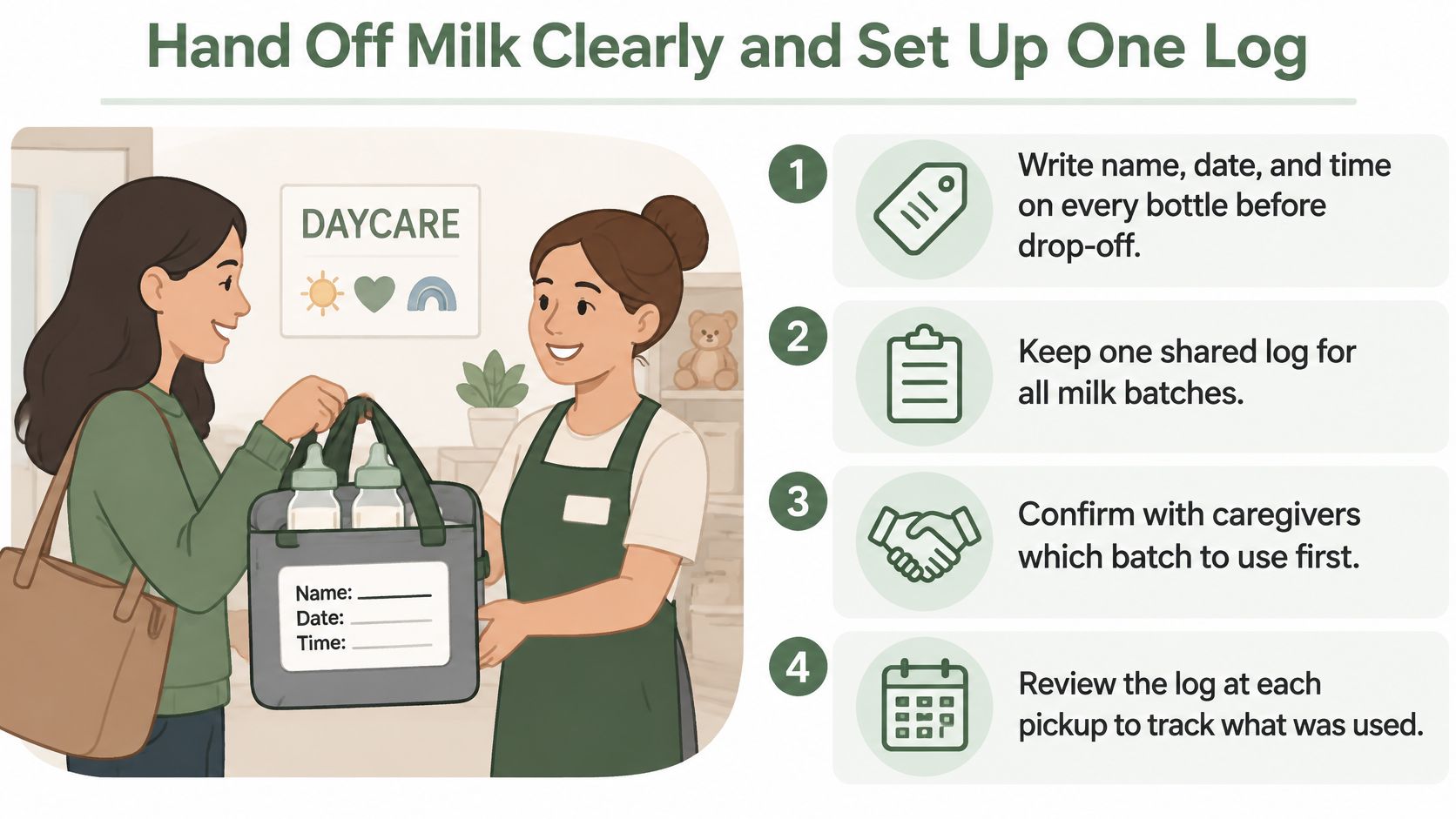
Every container works like a short chain of custody. The same details go on every bottle: the child's name, the pumping date and time, the storage state (fresh, frozen, thawed, or warmed), the thaw or warm time, and the discard deadline. The next person can read what happened to the milk and when it has to be thrown out, without calling anyone.
Spanish-speaking families, and grandparents who read Spanish more comfortably than English, can use the same fields. Fecha y hora de extracción and Usar antes de carry the pumping time and the discard deadline. A label in the language the caregiver reads gets checked instead of guessed at.
- Name what's first in line. When a shift changes, the outgoing caregiver says which container should be used next, out loud.
- State what's already been warmed and when. A warmed bottle has a short remaining window. That fact has to travel with the bottle, not stay in a text message.
- Have the receiving caregiver read the label before offering anything. Reading takes three seconds and replaces a phone call at 2 a.m.
- Check the deadline together on anything near its limit. Two people looking at the same label catch a date that one person might misremember.
A paper breast pumping log taped to the fridge door holds this timeline for many families. A shared app such as Cradlo keeps the same record in one place, with each caregiver logging under their own profile so nobody shares a login. Cradlo is one option among several. It is available on a 7-day free trial, then Plus monthly or annual, or Lifetime.
Keep a short card on the fridge with the three storage windows and the after-feed limit written on it, so the next person does not have to hold those numbers in their head. The record should answer one question without a call: is this bottle still safe, and who handled it last? Storage rules do not replace advice about a specific baby's feeding, medication, or health. A pediatrician or lactation professional is the right person for that. A steady routine, not a perfect memory, is what keeps the milk safe between caregivers.
If handoffs in your house would get easier with one shared timeline, Cradlo gives every caregiver their own profile and keeps pumping sessions, storage states, and feed times together. The log syncs across phones and the web, including the moment a nanny, a grandparent, or a daycare teacher needs to know which bottle comes first. Visit Cradlo to start a 7-day free trial. Plus is available monthly or yearly, and Lifetime is a one-time option.